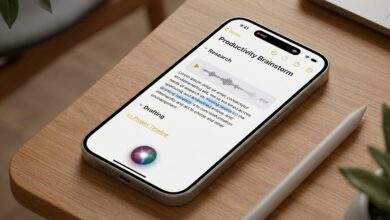
Direct Answer
Protecting your privacy with on-device AI agents comes down to three basic habits: locking down permissions, knowing where your files travel, and keeping a human in the loop for big decisions. Running an AI model directly on your hardware certainly cuts down on data exposure, but calling something “on-device” doesn’t mean your privacy is automatically guaranteed.
Marketing terms can easily blur the lines here—plenty of apps handle simple tasks locally while handing off heavier background processing to external cloud servers.

What Are On-Device AI Agents?
Unlike traditional chatbots that simply answer questions, modern AI agents actively handle complex tasks. They can scan through your folders, draft schedule updates, trigger connected apps, search online databases, and coordinate multi-step workflows with minimal hand-holding.
Because many of these apps rely on hybrid setups, you still need a clear picture of when your personal information stays on your chip and when it gets transmitted to a remote server.
Key Privacy Takeaways
- Keep access tight by limiting the agent strictly to the specific folder or task at hand.
- Regularly check operating system permissions for high-risk assets like your camera, contacts, photo library, and location.
- Pay attention to which tasks execute locally versus those requiring an external server connection.
- Verify whether your interaction history, files, or custom prompts are logged or used for background model training.
- Set up mandatory confirmation steps before letting an agent send messages, make purchases, or delete files.
- Create a clear boundary between your daily personal files and sensitive work or financial records.
- Grant temporary access to dedicated project folders instead of giving the app key to your whole hard drive.
- Unlink old background integrations and third-party tools the moment you stop actively using them.
- Revisit your privacy toggles after major app updates, as default settings can shift.
- Keep track of audit trails for automated background tasks so you can review what changed.
Managing App Permissions Step by Step
Audit every connected folder and app
Check both the standalone AI application and your system-level security settings. An assistant that only needs to reformat a single document shouldn’t have free reign over your personal photos or primary cloud storage drive.
Apply the rule of minimal access
It pays to map out the exact path your files take. Know which tasks are processed strictly offline, which steps hit the web, and whether your inputs get saved for model improvements down the road.
Set a routine review schedule
A quick monthly or quarterly check helps you spot forgotten background integrations that no longer need active access to your device.
Understanding Where Your Data Travels
Offline local execution
Processing data directly on your hardware minimizes external server hops. This keeps sensitive personal records, quick voice notes, and private documents contained within your own physical device.
External cloud models
Heavyweight cloud models offer serious computing power, but you need to know what leaves your machine, how long server logs persist, and whether third-party vendors store those interactions.
Hybrid setups and mixed workflows
Most on-device AI agents operate as hybrid systems that bridge both local hardware and cloud models. Always evaluate your security posture around the most sensitive piece of information in your pipeline rather than trusting a simple product label.
To see how major tech companies handle this balance without compromising end-to-end security, you can read more about Apple’s Private Cloud Compute security model.
Setting Up Human Approval Gates
Automated tools are fast, but high-impact decisions always need a manual check before they execute. Never skip a human sign-off for:
- Sending out emails, texts, or social media posts
- Triggering financial transactions or online purchases
- Wiping, moving, or modifying saved files
- Distributing internal or private documents
- Updating account preferences or security credentials
- Forwarding data off-device to third-party integrations
The Real Value of a Privacy-First Setup
Limiting an agent’s access dramatically shrinks its exposure window, making it far harder for personal information to accidentally leak. Setting up basic checkpoint prompts keeps you firmly in control while letting routine, low-risk automation run in the background.
For broader insights into user data rights and decentralized AI standards, explore Mozilla’s research on trustworthy AI and on-device privacy.
Frequently Asked Questions
Are on-device AI agents always private?
No. While on-device AI agents process tasks locally whenever possible, many still rely on remote cloud infrastructure, third-party APIs, or external integrations for complex workflows.
Does an AI assistant need access to my whole file system?
Not at all. You should only share the specific folders required for a task, and then revoke that access as soon as the job is complete.
Can AI agents send emails on their own?
They can, but leaving communication on full autopilot is risky. It’s much safer to require a quick manual preview and explicit confirmation before anything gets sent.
Is running AI locally always faster than using the cloud?
Not necessarily. Local processing speeds depend entirely on your hardware specs, the model size, and task complexity. Local execution is primarily about control and privacy, not raw speed.
Bottom Line
You don’t have to give up convenience to keep your personal files safe. Restrict file access, know exactly when data leaves your hardware, establish approval gates for big actions, and periodically audit your app permissions to keep your automated tools working for you safely.
Source: Capgemini TechnoVision Tech Trends. Explore enterprise guidelines on AI agent deployment, security, and governance on the official Capgemini Research Library.
Related Reading
- Related reading on techstormy.com: Why Ollama Makes Local AI More Practical; Why Context Engineering Is Replacing Simple Prompts.