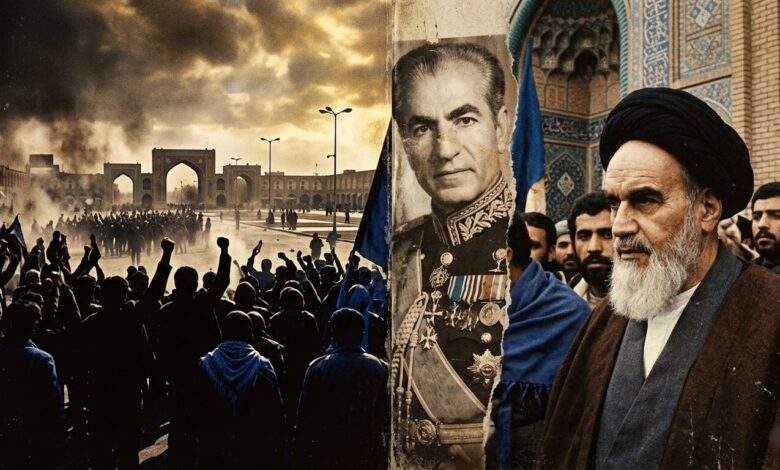
In February 1979, one of the most powerful monarchies in the Middle East collapsed suddenly. Shah Mohammad Reza Pahlavi fled his country and never returned. In addition, an Islamic Republic rose in his place under the leadership of Ayatollah Ruhollah Khomeini. This event, known as the Iranian Revolution of 1979, caught Washington entirely off guard. Ultimately, it transformed a secular monarchy into a theocratic state almost overnight.
Understanding why this revolution happened is essential today. Specifically, it provides the necessary context for decades of US-Iran tension and the rise of the Revolutionary Guard. For anyone watching modern Iran, the Iranian Revolution of 1979 is where the story begins. Furthermore, it remains a profound study of how rapid modernization can trigger a massive social backlash.
The Shah’s Iran: Wealth, Repression, and Social Gaps
By the 1970s, Iran was an oil-rich nation undergoing rapid change. However, the benefits of this wealth were deeply uneven across the population. The Shah had ruled since 1941 with British and American support. Consequently, a CIA-backed coup in 1953 reinstated him after he briefly fled. This intervention poisoned Iran’s relationship with the West for generations.
The Shah’s “White Revolution” brought land reform and women’s suffrage. Yet, it also uprooted traditional rural communities. Moreover, wealth flowed toward an urban elite while inflation soared. Meanwhile, the SAVAK secret police tortured and imprisoned political opponents. As a result, this shared experience of repression united groups that had nothing else in common.
The Unlikely Alliance That Fueled the Iranian Revolution of 1979
This uprising was distinctive because of its broad and varied coalition. Students, Marxists, and religious conservatives all marched together. Specifically, they were united by what they opposed, rather than what they wanted to build. Ayatollah Khomeini managed to hold this coalition together from exile. In contrast, many secular supporters wrongly assumed a democratic government would follow the Shah’s fall.
Secret networks and underground reading circles played a vital role in spreading these revolutionary ideas. If you find covert intellectual organizations fascinating, see our piece on Inside the Secret World of Syndicate X’s Book Room. Because of these networks, the revolution was able to scale at an incredible speed.
The revolution relied on three main pillars:
- Religious Networks: Mosques served as a powerful, nationwide communication infrastructure.
- The Bazaari Class: Traditional merchants financed the movement and subsequently paralyzed the economy with strikes.
- Youth and Students: University campuses became hotbeds for radicalized resistance.
1978: The Cycle of Protest and the Point of No Return
The revolution was built throughout 1978 in a cycle of protest and crackdown. Following Shia tradition, mourners gathered 40 days after a death. Consequently, each crackdown created new martyrs and larger gatherings. The “Black Friday” massacre in September 1978 marked a final point of no return. During this event, soldiers opened fire on crowds in Tehran, killing hundreds.
Immediately after, whatever goodwill remained for the Shah evaporated. Oil workers walked off the job, thereby cutting the regime’s revenue lifelines. When Khomeini returned on February 1, 1979, millions met him. Within ten days, revolutionary forces controlled the military. Finally, the Islamic Republic was officially proclaimed on April 1, 1979.
Lessons for Global Leadership and Modern Disruption
Western governments were caught almost entirely off guard. In fact, the CIA failed to see the revolutionary situation as late as August 1978. This failure was partly analytical. Agencies focused on military data rather than social and religious currents. Furthermore, it was a significant failure of imagination.
The lesson for any leader navigating change is clear: the signals are usually there. For a modern take on managing change, see our piece on Business Leadership for Navigating Disruption. Therefore, leaders must look beneath the surface to see shifting tides. While data is useful, Why AI-Written Books Can’t Capture the Human Touch reminds us that human emotion still drives history.
The Revolution’s Unfinished Business and Identity
The new government quickly sidelined its former allies. As a result, leftists and liberals were imprisoned or exiled. The 1980 hostage crisis cemented Iran’s international isolation. In addition, hardliners used the crisis and the subsequent war with Iraq to entrench their power. By 1989, the state looked very different from what early participants envisioned.
For those watching current protests, this history matters. Specifically, the tensions are not new. They revolve around identity and the legitimacy of the state. These struggles often mirror the journey of self-discovery found in literature, such as How The Alchemist Redefines Identity and Agency.
Key Turning Points at a Glance:
- August 1953: The CIA-backed coup shatters faith in democracy.
- September 1978: The Black Friday massacre radicalizes the masses.
- February 1979: Khomeini returns to fill the power vacuum.
Conclusion
The Iranian Revolution of 1979 was not inevitable. Rather, it was the product of specific failures and a breaking point of grievances. In the end, the events of 1979 remind us that a government’s strength is measured not by its weapons, but by its connection to the people it serves. Understanding this history is the only way to make sense of Iran’s current state. Ultimately, what happens next will be shaped by those extraordinary months nearly half a century ago.